
Most first-time founders don’t fail because they had a bad idea. They fail because they spent months building the wrong product for the wrong people in the wrong way. By the time they found out, the money was gone, the motivation was drained, and the window of opportunity had closed.

The fix is not more planning. It’s not a better business plan or a fancier pitch deck. It’s building a minimum viable product, an MVP, that lets you test your idea in the real world quickly, cheaply, and with minimal risk.
This post walks you through the complete process for going from a raw business idea to a validated, market-tested MVP. No startup theory. No fluff. Just the practical framework, step by step, based on the system outlined in The MVP Shortcut.
If you’re building a product right now, or thinking about starting one, this guide will help you avoid the most expensive mistakes and get to the truth about your idea as fast as possible.
Table of Contents
1. Start With the Problem, Not the Product
The number one reason MVPs fail is not poor execution. It’s that the founder built a solution to a problem that doesn’t exist, or doesn’t matter enough for people to pay to solve it.
Before you write a single line of code or sign up for any tool, you need to confirm that the problem you’re solving is real, specific, and worth building around. A problem worth solving meets three criteria:
- It’s specific. “People need better tools” is too vague. “Freelance designers waste five hours a week chasing late invoices” is specific enough to build around.
- It’s painful. People are already spending time, money, or energy trying to work around it. Mild annoyance doesn’t drive product adoption.
- It’s frequent. A problem someone faces once a year won’t sustain an MVP. You want something people deal with weekly or daily.
The best way to validate this is through real conversations. Talk to at least five potential users. Don’t pitch your idea. Just ask what frustrates them, what they’ve tried, and what’s still not working. When multiple unrelated people describe the same frustration, you’ve found a problem worth solving.
Then distill it into one clear sentence: “[Specific group] struggles with [specific problem], which causes [negative consequence]. They currently try [workaround], but it’s [why it falls short].” This becomes your compass for every decision that follows.
2. Define Exactly Who Your MVP Is For
If your answer to “who is this for?” is “anyone who wants to be more productive,” your MVP is already in trouble. Building for everyone means building for no one. A broad audience feels safer because it’s bigger, but broad means unfocused, and unfocused products don’t get traction.
| “The narrower your target user, the faster you’ll grow.” |
You need a focused user profile built on real conversations. Skip the demographics and focus on what drives behavior:
- What is their role or situation?
- What specific problem do they face, and when does it hit hardest?
- What have they already tried, and why did it fall short?
- What would a solution need to deliver for them to switch?
- Where do they go for help or information?
A strong user profile sounds like a real person you could find and talk to tomorrow. If it sounds vague or hypothetical, it needs more research behind it. This profile will guide your feature decisions, your testing strategy, and where you go to find your first users.
3. Scope Your MVP Ruthlessly
A minimum viable product is not a half-built version of your dream product. It’s the smallest version that delivers core value to your target user. It’s not a prototype, it’s not a demo, and it’s not an excuse to ship something broken. The features you include should work reliably. You just don’t need many of them.
The biggest trap at this stage is feature creep. Every feature you add delays your launch, dilutes your focus, and increases your risk. The discipline of a great MVP is not in what you include, it’s in what you have the courage to leave out.
Use the MoSCoW method to sort every feature you’ve imagined into four categories:
- Must Have – the product doesn’t work without it (limit this to 3–5 features)
- Should Have – important but the MVP can launch without it
- Could Have – nice for later versions
- Won’t Have – explicitly out of scope for now
For each feature on your Must Have list, ask one question: can the user still solve their core problem without this? If yes, move it down. Your MVP’s greatest strength is its focus. Protect it.
4. Choose the Fastest Path to a Working MVP
Your MVP does not need to be built the “right” way. It needs to be built the fast way. The goal is to put something functional in front of real users within 30 days so you can learn whether your idea holds up. There are several paths to get there:
- Concierge MVP – deliver the service manually to a handful of people before building any technology.
- Landing page + waitlist – test demand before building anything at all.
- No-code platforms – tools like Bubble, Softr, or Glide let you build working web apps without writing code.
- Stitched-together tools – combine Typeform, Google Sheets, Zapier, and Mailchimp into a functional MVP.
- The Wizard of Oz approach – build what the user touches, but handle the back-end processes manually until volume justifies automation.
The right choice depends on your skills and budget. The wrong choice is the one that takes longer than 30 days. If your current approach can’t get a testable MVP in front of five real users within a month, switch to a faster method.
Build an MVP People Actually Want
Stop guessing and start validating your idea. This step-by-step guide shows you how to quickly build a Minimum Viable Product, test it with real users, and avoid wasting time and money.
5. Test With Real Users, Not Friends and Family
Your mom will tell you it’s great. Your best friend will say it looks amazing. None of that is useful feedback. The people whose opinions actually matter are those who fit your target user profile, people who have the problem and are actively trying to solve it.
Find five to fifteen of these people through direct outreach, online communities, or your waitlist. Give them access to your MVP and ask five questions that surface honest, actionable feedback:
- What were you trying to do, and did the product help?
- What was confusing or frustrating?
- If you could change one thing, what would it be?
- Would you use this again next week? Why or why not?
- Who else do you know who has this problem?
| “Watch what users do, not just what they say. Behavior is the most honest form of feedback.” |
Never defend your product during feedback sessions. Your job is to listen and take notes. The moment you start explaining your design choices, people stop being honest.
6. Track the Metrics That Actually Matter
Page views, total downloads, and social media followers are vanity metrics. They look good on a dashboard and tell you nothing about whether your MVP is working. What you need are actionable metrics, numbers that change your decisions.
At the MVP stage, track no more than five:
- Activation rate – how many signups actually complete the core action?
- Day 7 retention – how many come back within a week?
- Core action frequency – how often do active users perform the main action?
- Feedback sentiment – is the overall tone of feedback improving over time?
- Referral indicator – are users telling others without being asked?
Set up a simple spreadsheet, update it weekly, and write two or three sentences summarizing what the numbers are telling you. This 30-minute weekly habit is your early warning system. It keeps you grounded in reality and prevents you from drifting into assumptions.
7. Iterate, Pivot, or Walk Away, Read the Signals
Once you have feedback and data, you need to make a decision. This is the moment that separates founders who build real products from those who stay stuck in an endless building loop.
You have three options:
- Iterate if the core idea is working but the execution needs refinement. Users are returning, feedback targets usability rather than the fundamental concept, and metrics are trending upward.
- Pivot if users confirm the problem is real but your specific solution doesn’t stick. Change the how, keep the who and why. This is not failure, it’s following the evidence.
- Walk away if nobody outside your personal network uses the MVP more than once, target users don’t recognize the problem, or metrics haven’t improved after multiple iterations.
If you’re iterating, use a one-week sprint cycle: identify the top two or three changes, implement them, test with users again, check the metrics, and repeat. Each cycle should produce measurable progress. If it doesn’t after several rounds, reassess whether you’re iterating toward the right destination.
8. Go From MVP to Market-Ready Launch
Market-ready does not mean perfect. It means three things: the core action works reliably every time, new users can get started without your help, and your systems can handle more users without breaking.
As you prepare for launch, resist the pressure to add more features. Use the 80/20 rule: double down on the features people actually use every day and say no to everything else until the data makes the case undeniable.
Position your MVP by leading with outcomes, not features. “Stop chasing late payments, get paid on time, every time” is far more compelling than a feature list. Collect testimonials from your early testers, set a launch price based on the value your product delivers, and pick a launch date within two to four weeks.
| “Your launch is not a grand reveal. It’s the next phase of learning.” |
Everything you’ve done up to this point, validating the problem, defining the user, scoping ruthlessly, building fast, testing honestly, measuring carefully, and iterating based on evidence, has prepared you for this. You’re not launching with hope. You’re launching with confidence.
The Bottom Line
Building a successful MVP is not about having the best idea, the biggest budget, or the most technical skills. It’s about following a disciplined process: validate the problem, know your user, scope ruthlessly, build fast, test with real people, measure what matters, and iterate based on evidence.
The difference between founders who launch and those who stay stuck in planning mode is not talent or luck. It’s action. Every week you spend perfecting something in isolation is a week of real-world feedback you’re not getting. And that feedback is the only thing that turns an idea into a product people will actually pay for.
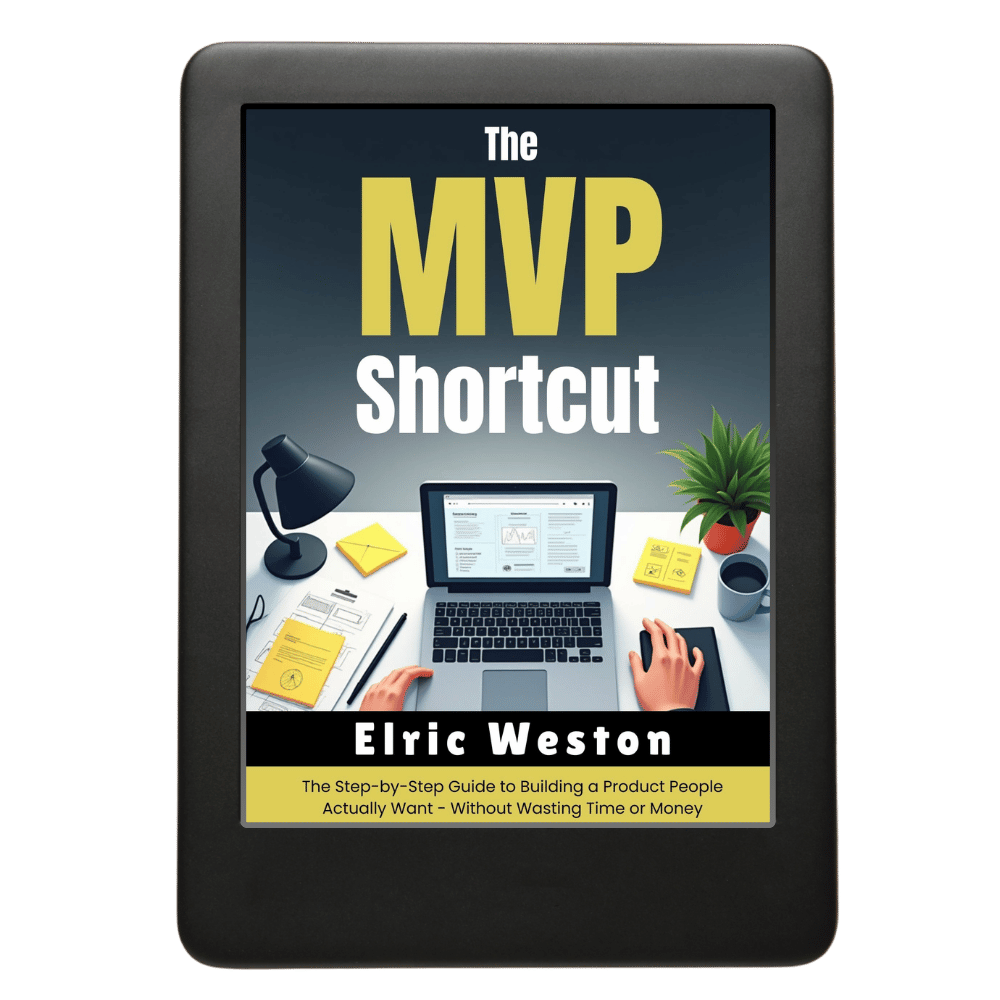
This post covered the complete framework at a high level. If you want the full step-by-step system, with action steps for every stage, ready-to-use templates, prioritization tools, feedback question guides, a metrics tracking setup, and a printable launch checklist, it’s all in The MVP Shortcut: The Step-by-Step Guide to Building a Product People Actually Want – Without Wasting Time or Money
Stop planning. Start building. The market is waiting.
FAQ
What is an MVP and why do I need one?
An MVP, or minimum viable product, is the simplest version of your product that solves a real problem for real users. It lets you test your idea quickly and cheaply before investing serious time or money into a full build.
How long should it take to build an MVP?
Aim for 30 days or less. If your approach takes longer than that, you’re likely overbuilding. The goal is to get something functional in front of real users fast — not to launch a polished, feature-complete product.
Do I need to know how to code to build an MVP?
No. There are plenty of no-code and low-code tools that let you build a working MVP without writing a single line of code. You can also use manual processes or stitch together existing tools to deliver the core experience.
How many features should my MVP have?
Three to five core features at most. Only include what’s essential for the user to solve their main problem. Everything else can be added later based on real feedback. Less is more at this stage.
How do I know if my MVP is working?
Track a few key metrics: are users completing the core action, are they coming back within a week, and are they telling others about it? If those numbers are trending upward and feedback is constructive rather than confused, your MVP is on the right track.
Build an MVP People Actually Want
Stop guessing and start validating your idea. This step-by-step guide shows you how to quickly build a Minimum Viable Product, test it with real users, and avoid wasting time and money.