

Table of Contents
If you’ve ever felt stuck trying to choose a freelance niche, you’re not alone. Most beginners struggle with too many options and not enough clarity, which often leads to underpaid work and inconsistent clients. The truth is, finding your freelance niche isn’t about guessing, it’s about following a proven process. In this guide, you’ll learn how to identify a profitable and sustainable niche step by step, so you can attract better clients and build a stronger freelance career.

1. Why Choosing a Freelance Niche Actually Increases Your Income
One of the biggest misconceptions about freelancing is that you need to offer everything to everyone to get more clients. In reality, trying to be a generalist often makes you invisible in a crowded market. When you choose a specific freelance niche, you make it easier for clients to understand exactly what you do and why you’re the right person for the job.
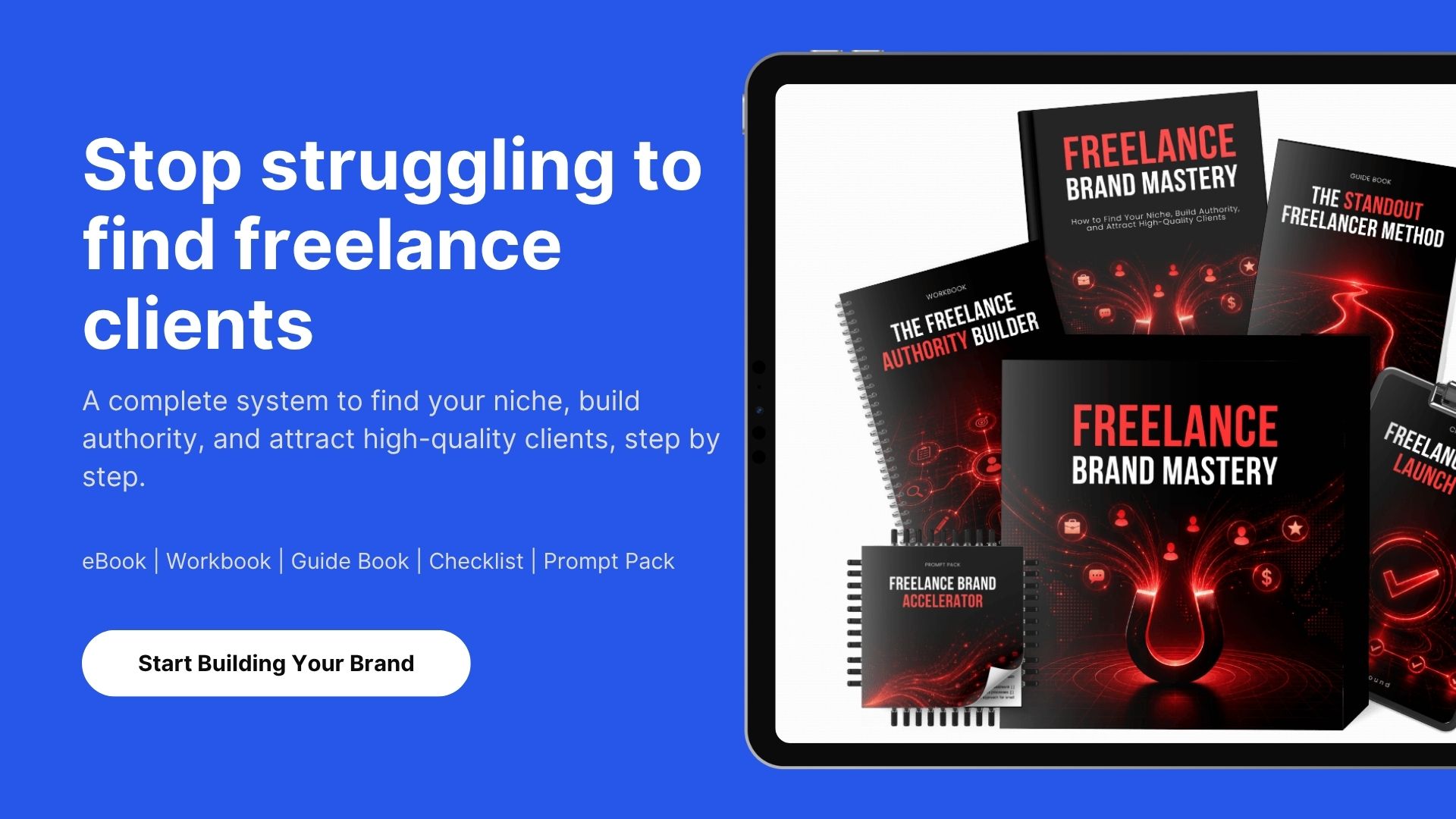
As highlighted in the Freelance Brand Mastery ebook, specialization positions you as an expert, not just another freelancer . This shift in perception is what allows you to charge higher rates and attract clients who are willing to pay for expertise rather than bargain for cheap work.
From an SEO and visibility standpoint, niching down also helps you target more specific search terms like “freelance writer for SaaS” or “logo designer for startups.” These targeted keywords bring in more qualified leads, which means less competition and better opportunities.
2. Audit Your Skills Using the Hard vs Soft Skills Method
Before you can choose a niche, you need a clear understanding of what you actually bring to the table. This is where a proper skills audit becomes essential. Instead of vaguely thinking about what you’re “good at,” you should break your abilities into two categories: hard skills and soft skills.
Hard skills include measurable abilities like writing, coding, or graphic design, while soft skills involve how you work, communication, problem-solving, and creativity. The ebook recommends rating each skill on a scale to identify your strongest areas , and this simple exercise can reveal patterns you might not notice otherwise.
When you look at your top-rated skills, you’ll often see natural combinations forming. For example, someone with strong writing and research skills might naturally fit into content writing or SEO blogging. This step ensures that your freelance niche is built on something real and sustainable, not just a trend you’re trying to follow.
3. Find Your Passion Signals (What You Naturally Enjoy Doing)
While skills determine what you can do, passion determines what you’ll keep doing. Choosing a freelance niche that drains you will eventually lead to burnout, no matter how profitable it seems at the beginning.
A useful way to approach this is by identifying what the ebook describes as “passion signals”, those activities that make you lose track of time or keep you curious without external pressure. These signals often point toward areas where you can sustain long-term consistency.
For example, if you find yourself constantly reading about marketing trends or watching design tutorials, that’s not random, it’s a clue. When your niche aligns with both your skills and your interests, your work naturally improves, and clients can sense that difference. Over time, this becomes a competitive advantage that’s hard to replicate.
4. Validate Market Demand Before You Commit
Even if you’re skilled and passionate about something, it won’t work as a freelance niche unless there’s actual demand for it. This is where many beginners go wrong, they choose a niche based purely on interest without checking whether clients are willing to pay for it.
Validating demand doesn’t have to be complicated. Spend time exploring freelance platforms, job boards, and LinkedIn listings to see what clients are actively hiring for. According to insights mentioned in the ebook, areas like digital marketing, data analytics, and emerging tech skills continue to show strong demand .
What you’re looking for is consistency. If you see repeated job postings for the same type of work, that’s a strong indicator of a healthy market. This step ensures that your niche is not just interesting, but also profitable and scalable.
5. Use the Overlap Method to Find Your Ideal Niche
Once you’ve identified your skills, passions, and market demand, the next step is to combine them. This is often referred to as the “overlap method,” and it’s one of the most reliable ways to find a niche that actually works.
The idea is simple: your ideal freelance niche sits at the intersection of what you’re good at, what you enjoy, and what clients are paying for. The ebook describes this intersection as the “sweet spot” for niche discovery , and it’s where most successful freelancers operate.
For instance, if you’re skilled in writing, interested in technology, and notice strong demand in SaaS companies, you’ve just identified a potential niche: SaaS content writing. This approach removes guesswork and gives you a clear, logical direction to follow.
6. Test Your Niche Without Taking Big Risks
Choosing a niche doesn’t mean you have to commit to it immediately. In fact, one of the smartest things you can do is test your niche on a small scale before fully diving in.
The ebook emphasizes starting with low-risk experiments, such as creating sample projects or taking on small gigs . This allows you to understand client expectations, refine your skills, and see whether you actually enjoy the work.
Testing also helps you build a portfolio, which is crucial for attracting better clients. Instead of waiting until you feel “ready,” you start learning by doing. This approach reduces uncertainty and gives you real-world feedback that no amount of planning can replace.
7. Refine Your Freelance Niche as You Grow
Your niche is not something you choose once and stick with forever. As you gain experience, your skills improve, your interests evolve, and the market changes. This means your niche should also adapt over time.
The ebook highlights that refining your niche is an ongoing process, not a one-time decision . Many successful freelancers start broad and gradually specialize as they discover what works best for them.
For example, someone might begin as a general writer, then move into blog writing, then SEO writing, and eventually specialize in a specific industry like SaaS or healthcare. Each step makes their positioning stronger and their services more valuable.
Ready to Build a Freelance Brand That Attracts Clients?
Stop chasing random advice and start building a brand that gets noticed, trusted, and paid with a clear system that works.
Final Verdict
Finding your perfect freelance niche doesn’t have to be overwhelming. When you follow a structured approach—understanding the value of specialization, auditing your skills, identifying your interests, validating demand, and testing your ideas, you remove the confusion and replace it with clarity.
The key is to take action instead of waiting for the “perfect” niche to appear. Start with what you have, test it, and refine as you go.
If you want a faster and more structured way to do this, the Freelance Brand Mastery ebook provides a complete framework, worksheets, and practical strategies to help you discover your niche and build a strong freelance brand. It’s designed to take you from confusion to clarity, and ultimately to consistent, high-quality clients.
Frequently Asked Question
What is the best freelance niche right now?
The best freelance niche depends on your skills, but high-demand areas include SEO writing, digital marketing, web development, and data-related services. The key is to match demand with your strengths.
How do I know if my freelance niche is profitable?
You can determine profitability by checking job boards, freelance platforms, and client demand. If businesses are consistently hiring for that service, it’s a good sign your niche has potential.
Can I change my freelance niche later?
Yes, and most freelancers do. Your niche should evolve as you gain experience and discover better opportunities.
Do I need to be an expert before choosing a niche?
No. You only need a foundational skill level. You can build expertise over time by working on real projects and continuously improving.
How specific should my freelance niche be?
Start moderately specific, then refine over time. For example, instead of “writer,” go for “blog writer,” and later narrow it down further like “SEO blog writer for SaaS companies.”